|
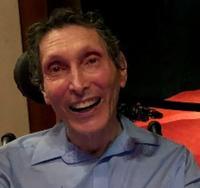
Rabbi Ronnie Cahana, 72, continued to teach and inspire at his Montreal synagogue after a devastating stroke
'His sincerity and decency were tangible. He was deeply loved and respected across the entire community.'
Rabbi Ronnie Cahana was already recognized as a leader in interfaith work and social activism in addition to his duties as a pulpit rabbi at Congregation Shaare Zion Beth-El in Montreal when he had a debilitating stroke in 2011. Following the stroke, he continued his work at the Conservative synagogue as rabbi emeritus for another 15 years, seeking to inspire others, and continuing to teach and write with unending optimism and gratitude.
He died in Montreal on Aug. 13. He was 72.
Rabbi Cahana served as spiritual leader of Congregation Shaare Zion Beth-El for 10 years when he had a brain stem stroke that left him in a quadriplegic state only able to communicate with his eyelids. He regained his speech and through physiotherapy he also regained some motor skills but required full-time care. At the time he had his stroke he was 57 and he and his wife Karen had five children ranging in age from 13 to 23.
“Fifteen years ago, the man who devoted his life to brachas of healing had his world fold inward,” his son, Rabbi Dvir Cahana said in his eulogy. “In an instant a stroke upended all his dreams. He found a sudden cul-de-sac at the road where he thought he was headed. He was needed for a different mission. My father re-emerged from the calamity of the stroke and reconstituted himself. He continued his rabbinate albeit differently but with as much fervor as before. His mind and his spirit were as stiff-necked as his stiff neck!”
Rabbi Adam Scheier of Shaar Hashomayim in Montreal told The CJN that he visited Rabbi Cahana shortly after his stroke. “At the time, his sole means of communication was by blinking out the alphabet. With a smile on his face, he painstakingly blinked the following question: ‘What was the topic of your sermon this week?’ I shared my speech with him, he smiled and he then blinked an insight that built on my idea. The entire exchange of just a few sentences took 15 minutes to communicate; at no point did he show any frustration or impatience. Instead, he showed a thirst for learning that remained undiminished.”
Rabbi Cahana was born in Borås, Sweden. His father Rabbi Moshe Cahana grew up in Israel where his own mother and grandmother were murdered by terrorists before the state was declared. His mother, Alice Lok Cahana, was a Hungarian artist who had survived Auschwitz and Bergen-Belsen. Ronnie was the first of their three children and was part of a Jewish dynasty of Hasidic rabbis that stretched back centuries. His father’s side descended from Rabbi Elimelech of Lizhensk and according to the family, the Berditchever Rebbe. On his mother’s side he is related to the Chatam Sofer, Rabbi Moshe Schreiber, a great Talmudic scholar who was the preeminent leader of Judaism in the Austro-Hungarian Empire in the late 18th century and whose ideas and opinions differed enormously from the Cahana patriarchy.
Rabbi Cahana was raised in Texas where his father became a leader of the Houston Jewish community. His father was a champion of women’s full participation in Jewish religious life and he also was known for leading a group of rabbis marching in Selma, Ala., in the 1960s against segregation.
“His parents loved him so dearly and believed in him so profoundly,” his son said. “His successes were their greatest joys.”
His parents encouraged his athletic abilities as well as his writing and curiosity.
When he was 17, he met his future wife Karen at a Young Judaea of Texas camp. His relationship with his wife and children and the intensity of that bond nourished his optimism. “His funeral was a remarkable tribute to his lasting impact. Each of his children spoke and each brought forth a unique aspect of their father’s voice and legacy,” Rabbi Scheier said.
Rabbi Cahana’s many achievements and adventures included a three-year-long honeymoon through war-torn countries in South America, a peace mission in Sarajevo with a priest and an imam where his son said he blew a shofar blast into the air as bullets whizzed by his face. He received a Swedish Peace Prize for co-founding the Nordic Center for Inter-religious Dialogue and for his peace mission during the Bosnian war. He advised a Supreme Court ruling to help agunot, ‘chained’ women unable to receive a Jewish divorce decree, free themselves from abusive husbands. And, after months on the forefront of an advocacy group fighting for the rights of patients at the Donald Berman Maimonides Geriatric Centre in Montreal, he was the first recipient of the COVID vaccine in Canada. In 2012 he was awarded the Queen Elizabeth II Diamond Jubilee Medal.
In the 2021 documentary, Perfecting the Art of Longing, his daughter, filmmaker Kitra Cahana documented his experience during the COVID lockdown and the bonds with his family that were able to sustain him during the darkest times.
“I’ve lived nine years in my bed,” he said in the film. “My needs are endless since the stroke. All the things that are simple are beyond me. You perfect the art of longing by knowing where your soul is intended to be. I don’t want to die. I want to live deeply. So, I travel through my imagination. My family. My soul’s reflection, my triumph is waiting for me. Such is longing. You can smile at the past, but longing is the memory you don’t have yet.”
The 12-minute NFB film which Rabbi Cahana narrated through his thoughts and poems won the Hot Docs award for Best Canadian Short Documentary.
Following his stroke, he continued in his role as rabbi emeritus at his synagogue writing Torah commentary, and poetry. He continued teaching and was immersed in learning Maimonides’ Guide for the Perplexed a week before he died. He also continued to connect with, support and inspire members of his congregation. His son said, “He cared for his congregants viscerally. He wasn’t walking alongside them, he was in their shoes. He would follow up consistently with people he hadn’t seen in decades. Some people have different love languages. But for my father, love was his language.”
Rabbi Cahana’s family described him as a “Chagall-man” – the figure floating between heaven and earth in many of his paintings. His brother, Rabbi Michael Cahana said, “He lived his life with a sense of joy, wonder and gratitude. Teaching was his greatest delight. Ronnie was never rooted in the ground. He floated. He was always floating in mid-air. Living his life in a place that none of us could quite glimpse.”
Rabbi Reuben Poupko of Beth Israel Beit Aaron Congregation told The CJN, “Rabbi Cahana was a remarkable man, who despite challenges, had an enormous impact on many. His sincerity and decency were tangible. He was deeply loved and respected across the entire community.”
He is survived by his wife of 42 years, Karen, his brother Rabbi Michael Cahana and sister Rina. He is also survived by his children Kitra, Tamira, Briah, Rabbi Dvir Cahana and Sapira and his grandchildren. He is predeceased by his parents Rabbi Moshe Hillel Zion Cahana and Alice Lok Cahana. https://thecjn.ca/news/obituaries/rabbi-ronnie-cahana-72-continued-to-teach-and-inspire-at-his-montreal-synagogue-after-a-devastating-stroke/
|
Judy Elkins
We are so sad to hear that Rabbi Ronnie Cahana has passed away. We were very fortunate to have known him at Bellaire HS. He was loved so deeply by his family as well as his congregation.
Ronnie's wife Karen has sent us another beautiful obituary. Thank you, Karen.
https://www.paperman.com/funerals/Rabbi-Ronnie-Cahana-00A6979E
Rabbi Ronnie Cahana
BS”D
Cahana, Rabbi Ronnie
Transcended gently in the presence of his Bashert, Karen, with whom he shared an eternal love for over forty-two years, on Thursday, August 13, Rosh Chodesh Elul (30 Av).
The wellspring of his love overflowed into his children Kitra, Tamira, Briah, Dvir, and Sapira, who adored him endlessly. He lovingly embraced his growing family: Fletcher and granddaughter Rakiya Aliz, Shane and granddaughter Tzofia Peleia, and Shalhevet. Proud brother and brother-in-law of Rabbi Michael and Cantor Ida Rae Cahana, Rina Cahana — who is the heart of the family, and brother-in-law of Janet and Bob Boraz, and Judy Knie. The family is comforted by the Almighty that he is now reunited with his parents Alice Lok ZTz”L and Rabbi Moshe Hillel Cahana ZTz”L, and that he is now meeting for the first time his aunt, two uncles, grandmother, and great-grandfather who were taken in the Shoah, who he yearned to meet all his life. Rabbi Ronnie will be fondly remembered by his nieces, nephews, extended family, friends, and by all those whose lives he touched. His impact and inspiration will be imprinted upon the hearts and souls of the Shaare Zion Beth-El Family and the greater Montreal Jewish community. He was blessed by myriads of angels who supported his life’s mission to infuse poetry, Torah, and the Sacred into every moment and interaction. He taught the power of mutual vulnerability to experience Divine healing.
Soon after his stroke he blinked out letter by letter: “I am in a broken place, but there is holy work to do.” He spent the next fifteen years doing that work.
The family expresses their heartfelt gratitude to the dedicated staff of Maimonides and to all those angels in his midst who split the Red Sea for him.
Funeral service from Paperman and Sons 3888 Jean Talon W on Sunday August 16 at 11 am. Burial at the Shaare Zion Beth El Congregation, Beth El Section, Eternal Gardens Cemetery, Beaconsfield. Shiva at the family home. Contributions in his memory may be made to the “Rabbi Ronnie Cahana Memorial Fund” ℅ Shaare Zion Beth El Congregation at (514) 481-7727 or click here.
While this is a tremendous loss for Olam Hazeh, it is the most incredible gift for Olam HaBah.